"What perfect timing to do research here on the Israeli-Palestinian conflict than during another war," said the Israeli passport official when I arrived at the Tel Aviv airport on the night of January 2. I planned on this whole 3 week research trip ever since I left the Holy Land last August and for a region continuously in conflict, I wasn't really too surprised with Gaza flaring up again. It happens. Israeli elections are next month. The US is under a transition period. Gaza was illegally under siege by Israel for 18 months. Both sides violated the last ceasefire. So Israel and Hamas are back at war with each other. Israel invades Gaza on my first day here. Go figure.
At least I was able to get away from the biased US media coverage of the war that I was stuck with at home in DC, which was a real relief. I still want to throw my shoe at Israeli spokesman Mark Regev every time I see him on TV on a blatant Israeli PR campaign. He and all of US media conveniently leave out any facts critical of Israel or its actions in the last 18 months. Seriously, anyone with a memory span longer than 18 months (or even 6) should know that Israel and its policies share as much or more of the blame and responsibility as Hamas for the current war. "War is a defeat for humanity" (Pope JPII) and the diplomatic and policy failures of Israeli, Hamas, and Palestinian Authority leaders are what brought this current war upon the Israeli and Palestinian people.
On the ground here, it's all the usual. Palestinians are pissed off. 42 years of illegal military occupation and martial law does that. Israelis are indifferent. It's all typical Israeli politics before elections. The usual. If anything, the current Gaza war just pushed back a few years any hope for serious peace negotiations. The Syrians and even the moderate Palestinian Authority already suspended their peace talks with Israel. The US's blind support for Israel only makes matters worse. Good luck Obama. Welcome to DC.
I'm writing my senior thesis on the Arab-Israeli conflict and my own personal proposal for a permanent peace in the region, not just with Palestinians but taking into account the Iran-Syria-Hezbollah-Hamas axis. And of course, any serious work requires comprehensive research encompassing every perspective available and that's what brings me back here and what will bring me back to Lebanon and Syria this summer. For the record, I wouldn't consider myself either pro-Israeli or pro-Palestinian. My Arabic professor described me more as pro-peace and I guess I'll just settle for that. Peace for the Palestinians requires justice. Peace for the Israelis requires security. Both sides have the right to justice and security and to deny them these two basic rights, among other things, will only serve to perpetuate the violence that has beset both Palestinians and Israelis. Last time I was here in August for two weeks as an aid worker volunteer at a Palestinian Refugee Camp in the West Bank (just outside Bethlehem) so I mostly only got the Palestinian perspective from a refugee point of view, who are mostly just really pissed off (and rightfully so). And the only Israelis I met here last time were human rights activists and soldiers opposing the ongoing occupation. Anyway, here's my schedule and list of most important meetings:
1/2:
Arrival in Tel Aviv.
1/3:
Dead Sea and South Israel. Noticed about half a dozen Israeli F-16 jets flying south towards Gaza. No rockets from Hamas though.
1/3 - 1/10:
Staying in Jerusalem.
1/5:
Meetings with the Palestinian Authority in Ramallah, the West Bank.
- Ahmed Qurei, Chief Palestinian Negotiator since 1993 Oslo Accords and former Prime Minister under Yasser Arafat
- Ahmed Subuh, Deputy Foreign Minister (was originally supposed to meet with Riad Malki the Foreign Minister but he had to go to the UN to settle the Gaza crisis)
- Rafiq Husseini, Chief of Staff to President Abbas
- Muzna Shihabi, Negotiations Department of the PLO (Palestine Liberation Organization)
- Mustafa Bargouthi, Opposition Member of Parliament.
- Hamas official (canceled)
Visit Qalandia Refugee Camp outside Ramallah.
- Another Palestinian today asked me again if I was either Chinese or Japanese. As usual I reply I'm Filipino and then he asks me what the Philippines is. I guess Asians don't go to Palestine too much these days.
Also ended up in the middle of a Palestinian protest in downtown Ramallah against Israel. Then got back to the hotel room and saw footage of it on CNN.
Discussion on the war in Gaza of course took up most of the meetings. Also went over the current peace process with Israel, internal Palestinian politics, relations with Hamas, the new US administration, the role of Arab states, Israeli elections, etc.
1/6 - 1/7:
Meetings with Israeli officials at the Israeli Ministry of Foreign Affairs.
Tour of Jewish settlements in the West Bank.
1/8:
Visit to Israeli Parliament (the Knesset).
1/10:
Meeting with Governor of Bethlehem.
1/11 - 1/12:
South Israel.
1/13:
Tel Aviv and Jaffa.
Meeting with Gideon Levy, journalist for Ha'aretz (Israeli newspaper)
1/14:
Meeting with Oslo negotiator Ron Pundak.
1/15:
Meeting with Mayor of Nazareth, Ramiz Jaraisy.
1/16:
Meeting with the United Nations peacekeepers in the demilitarized zone of the Golan Heights (United Nations Observer Disengagement Force) at Camp Ziouani.
Meeting with the Israeli Army on the Israel-Lebanon/Hezbollah border.
1/18:
Tel Aviv to NYC to DC to Detroit to Chicago to Notre Dame.
I almost was going to stay in DC for the inauguration on 1/20 but I figured I already missed the first week of class. Maybe I'll catch the next one.
January 05, 2009


December 04, 2008
October 20, 2008
Colombia
Pre-Departure:
I had been unsure of what to do for Fall Break. NYC, Canada, or both were the leading candidates. Aldrich and David expressed interest in going but when we met at Lafortune on Friday, October 17 to buy bus tickets, the plan started to fizzle out. Around 1am, I looked at a map of the world and randomly proposed Colombia. There wasn't too much interest at first but when we compared ticket prices to other random spots (Peru, Mexico, Germany, Canada), Colombia won out in the end as being both cheap and obscure/interesting. The State Department has a travel warning issued for Colombia, urging all Americans to avoid traveling in the country but that didn't really bother us too much. Well, it may have bothered some of us (or one) but we ended up going anyway so it didn't matter. It may have helped that I've been to 7 countries with travel warnings in the last 7 months and I ended up still alive. So after proposing the idea at 1am, we had our tickets purchased by 3am. We were going to fly out of Chicago on Saturday, October 18 at 5pm.
Day 1: We had a 5 hour layover in Houston on Saturday night but our plan to visit the city failed. I've been to Texas 5 times since January and with probably somewhere over 24 hours of layovers total, I've still never left the airport. Oh well. We got into Bogota, the capital of Colombia, at 5am and after arriving at the hostel in central Bogota, we passed out on the hard beds for 5 hours. We only wanted to sleep 2 hours but the flight and lack of sleep on the plane left us exhausted. Around 11am, we got up and had breakfast in the kitchen (pieces of toast and eggs) and then proceeded to exploring Bogota. Located 8500 feet in the Andes mountains and with a population of 8 million, Bogota is probably one of the most interesting capitals of Latin America. The old city is mostly comprised of colonial-style architecture, with one-lane streets, soldiers armed with assault rifles on every block, a main square, and many old Spanish churches. It reminds me a lot of Quito in Ecuador. The Andes mountains surround the city and make it all the more beautiful. Conquistadors really know how to pick good places to found cities. So we just walked around the old colonial city all day, visiting museums, old churches, and doing some people-watching in the main square, the Plaza de Bolivar. Lunch cost us $4 and included a full meal of chicken, rice, salad, and beer.
We're back at the hostel now. Aldrich and David are passed out. We're going to go out and check out the Colombian nightlife later. Beer's about 50 cents a bottle and is your basic Latin American light, watered down beer. Still better than Natty though. Adios.
Spot the gringos
Bogota
Plaza de Bolivar
Day 2:
Last night we probably did the most gringo thing we could. We took a taxi to the neighborhood around the local university and had 11pm dinner at Bogota Beer Company. We had cheeseburgers, fries, and beer for dinner. And we watched the Red Sox-Rays game on Latin American ESPN.
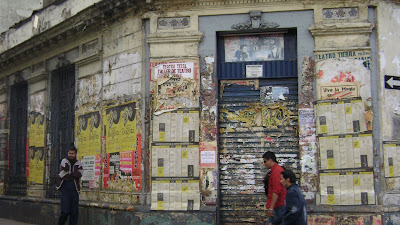
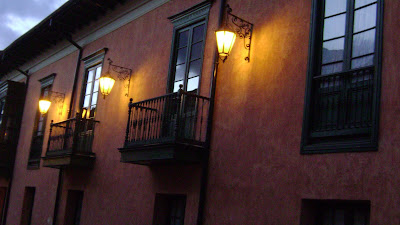
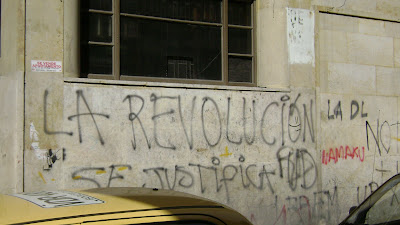
Woke up this morning around 9am and went to all the places we didn't go to yesterday. Except all the museums we wanted to go to are all randomly closed on Mondays. All the buildings in the colonial district (La Candaleria) are painted in bright colors... red, blue, yellow, green etc. And there's a lot of graffiti everywhere. Some of them are anti-government and support the revolution (Viva Revolucion!) and I've seen a few FARC ones. Hmmm... Also, apparently on Sundays the roads are closed to traffic so we had to deal with crazy Colombian drivers who regard stop signs (Pare) and red lights as suggestions and not rules. David hasn't been hit by a car. Yet. Our cab driver last night just ignored the red lights and sped through. Another observation: locals are not bilingual. They speak Spanish. Just Spanish. Not even a little bit of English to have a small conversation. I haven't used English with a local yet so I've been relying on my Spanish. But then again, after 7 years of Spanish classes my Spanish is still pretty bad. It's true. If you don't use it, you lose it.
Today, went up Monserrate which is the local mountain overlooking the entire city of Bogota. 9300 ft. There was a church at the top and we went to 1pm Mass. It was all in Spanish of course. Colombia is 90% Roman Catholic. And very devout. The main cathedral in Bogota had Opus Dei posters up. The 80th anniversary of OD was just a few weeks ago. Also we walked around the Presidential House, the Colombian White House I guess. Security was tight with dozens of soldiers and police armed with assault rifles every block. Yeah, a lot like Beirut. But at least they don't hate cameras as much as Lebanese soldiers do. We took as many pictures as we wanted. Anyway, we've had enough of the city so we're heading into the Amazon jungle and over to the Caribbean coast for the rest of the week. There's some small towns/villages a few hours north of Bogota, called Tunja and Villa de Leyva. We're taking a $6 dollar bus at 2am so we'll be there in the morning in time for the sunrise. Hasta luego.
Bogota, 9300 ft.
Viva la revolucion!
Dia Tres:
Last night, checked out of the hostel and after a bit of a delay (David) we made it to Zona Rosa for dinner, an upscale neighborhood in Bogota. Most of it reminded me of Georgetown back home in DC. Expensive restaurants, outdoor bars, brick mansions, malls, etc. Except the houses had barbed wire on the fences. And every block had several fully armed Colombian soldiers in full gear. Hmm...After another late night dinner (Latin American style) at 11pm, we just sat around at a bar (Beer Station) enjoying the nightlife atmosphere and Colombian cerveza. Our last bit of civilization before heading into the countryside.
Left Bogota at 1am on a bus to Tunja. Nicest bus I´ve ever been on. Missed our stop because we fell asleep (the bus was that comfortable). The conductor was actually more worried than we were. Went an hour in the wrong direction. Turned around and got into Tunja around 5am. Took the 6am van to Villa De Leyva. Aldrich and David passed out in the back of the van and missed out on some picturesque scenery through the Andean Mountains and Colombian countryside. Small crosses litter the roadside, marking the spot where someone was killed. They´re everywhere just like in Ecuador. Latin American drivers speed around the winding mountainside roads, just a few feet from the cliffside and a few thousand feet drop. Anyway, got into Villa De Leyva at around 715am.
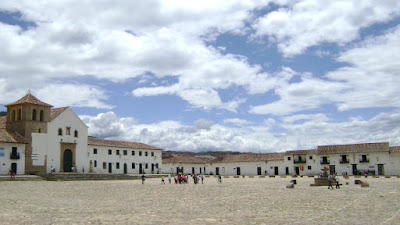
Villa De Leyva is a small town a few hours north of Bogota in the Andes Mountains, which surround the town. Time literally stands still here. There is no modern architecture at all in town. All the colonial-era buildings have been preserved and the town remains mostly unchanged since the early 1600s. The streets are still made of cobble-stones. The church was built in 1608 and hasn´t changed since. The main square is the largest in Colombia. The locals still live mostly simple lives compared to their fellow citizens in the bustling metropolis of Bogota. They´re a lot more friendly too. While Aldrich and David were asleep again after checking into our hotel, that morning I just sat in the main square. Everyone from small children to teenage students to elder couples to stray dogs stopped by to say hello and converse. Didn´t get to far with my Spanish, though.
Strolled through the narrow, cobble-stoned streets for most of the day, just taking in the small colonial town atmosphere. We´ve been doing our best to simulate Latin American culture. We eat small simple breakfasts. Then eat a huge lunch in the afternoon (cheap too, like $5). Then eat dinner around 10 or 11pm. It actually works well. After 2 weeks of doing it in Ecuador, going about 11 or 12 hours without a meal isn´t that bad.
Tonight will probably be a bit quieter than our nights in Bogota. Tomorrow, we´ll try renting out some horses and exploring the countryside outside town ($2 an hour) and then we´ll take the 20 hour bus to Cartagena on the Caribbean coast. Esta de juevos.
Plaza Mayor
Colombia
Andes
VDL
locals
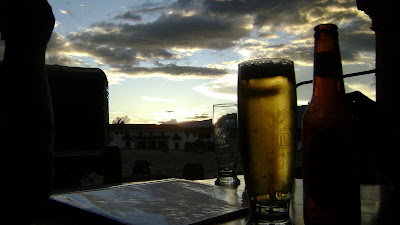
.50 cent beer and the sunset
Dia Cuatro:
Woke up. Left the hotel. Detained by the Colombian police who thought we were carrying drugs. They asked Aldrich if David was about to cry. I don´t know. Maybe we look like stoners? Or the police are that bored with looking after tourists all day, everyday. If we get stopped again, we´ll just tell them we´re seminarians. Bus back to Tunja. Bus from Tunja to Cartagena. $50. 20 hours. Left at 1230pm. Nicest bus I´ve ever been on. And in South America of all places. Yeah, that´s what I thought at first. Before the bus driver cranked the A/C to full blast the whole time and turned the bus into an icebox. With my jacket and keffiyeh both on, my teeth were still tattering. Movies playing included (in Spanish of course) National Treasure 2, Rush Hour 3, and Zohan (Israeli propaganda...wow). 20 hours on a bus doesn´t sound that bad. If it were on an American highway. But this isn´t America. It´s not even the Middle East. The roads are terrible... full of potholes, bumps, winding turns, only two lanes, with random villagers on the side of the road. I literally counted. The bus could not go more than 10 seconds without hitting a bump. Just like Ecuador. Worst ride of my life. Impossible to sleep or read a book. We´re definitely flying back to Bogota.
At least the scenery was nice, even with the motion sickness. From 9000 ft in the Andean Highlands, we descended all the way to sea level on the Caribbean coast. Very picturesque stuff. The road passes through small villages and towns. It kept reminding me of Ecuador and the Philippines. People just lounging in a plastic chair in front of their concrete house, just watching the traffic go by all day.
Dia Cinco:
Got into Cartagena at 8am. The hostel is in the middle of the old colonial town. $3 a night. The room wasn´t ready until 11am so I just passed out in the tv lounge while the Europeans watched Fox News and debated the US elections. They like Obama. Hmm...
Got lunch around the corner at Restaurante Coronado. $4 for a plate of delicious arroz con pollo y papas fritas con cerveza Colombian. Muy excelente. I can describe the weather here on the Caribbean coast in one word: hot. In two words: hot and sticky. I sweat more sitting down eating at a restaurant here than I do running 6 miles at Notre Dame.
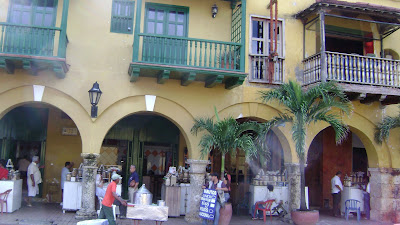
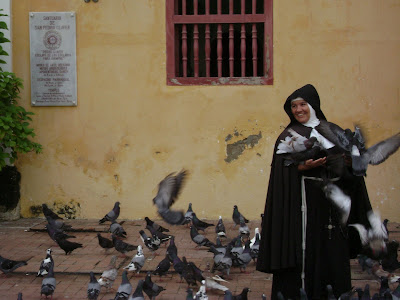
But the 20 hour bus ride and the mucho calor weather make this old colonial town on the Caribbean coast the highlight of any trip to Colombia, or maybe even to South America. Founded in the 16th century, Cartagena was the jewel of the global Spanish empire as it was the gateway to South America and the main port in the New World. It was here that the conquistadors shipped all their plundered Indian gold back to Europe. It was here that pirates such as Sir Francis Drake sacked the port for booty. Located on the coast, there are a lot more blacks here than in the Andes mountains. The descendents of African slaves brought here in the colonial period, they´ve created a distinct Creole culture distinctive from the culture of the mountainous regions. Today the town is famous for perfectly preserving its colonial architecture in the old town. We walked around the old town all day, just admiring the simple but inspiring colonial buildings, with bright colors and balconies overlooking the narrow streets. It reminds me of Jerusalem. People can just walk freely in the streets without the noise and disruption that traffic brings. Street vendors sell delicious local snacks (empanadas) and fake Cuban cigars. Streetlife is what makes Cartagena special. Musicans play vallenato on the corners. Horse-drawn carriages and mules walk through the streets, a reminder of the old colonial days.
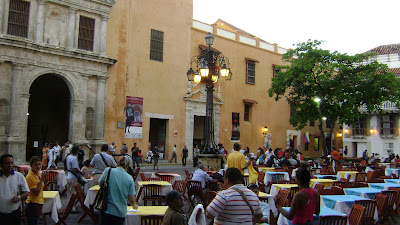
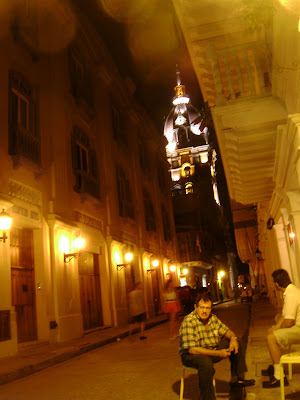
At night when the sun goes down is when the place really comes alive. Local dancers perform in the square. Outdoor cafes and restaurants in open plazas reminisce of old Europe. But this isn´t Europe. It´s Colombia. The best difference is that you won´t go broke paying for everything here.
We did meet a Jesuit priest here at Iglesia San Pedro Clover, the first to be canonized in the New World. Aldrich had a long conversation with him in Spanish while I tried to follow along. He did mention Opus Dei, at which point I told him in Spanish that I lived in an Opus Dei Center in the US. Apparently he considers Opus Dei an "enemy" of the Jesuits, whatever that means. Maybe something got lost in translation.
Anyway, we had dinner at this outdoor restaurant in one of the open squares. There was a group of Creoles dancing to their tribal-like music. But they were dressed in Spanish clothing. And they speak Spanish too of course. Blending of cultures. We went into this supermarket afterwards and David managed to get separated from us. We lost him. In a sketch part of town. In the middle of a foreign city. In Colombia. We found him later though.
Cartagena
Dia Seis:
Woke up to a loud Colombian man yelling "Newspapers!" every few seconds at 7am. David punched me in the back while sleeping. He snores so loud. Bought airline tickets at a travel agency. $150 one way Cartagena to Bogota. Expensive but definitely better than 20 hours on the bus ride from hell. Took a cab to the Castillo de San Felipe, built in the early 1600s. The strongest and most formidable fortress ever built by the Spanish Empire. Cartagena was that important to Spain and her empire. If they lost Cartagena, they could´ve lost the entire continent or the whole Caribbean. The fortress was the first of its kind, implementing innovating military engineering. Maybe that´s why the fortress was never captured despite numerous attempts to storm it, by pirates, the English, and local Indian tribes. This is also why Cartagena was the last South American city to receive independence from Spain.
Ran into some old guy named Raymundo who offered to take us around Bogota for 30,000 pesos. After some deliberation, we accepted and he drove us the the highest hill in the city. At the top was the Conventa de la Popa, or Convent of the Stern. Apparently the hill looks like the back end of a ship. Founded in 1607 by the Augustine Padres, the hill overlooks the entire city. Buena Vista. After driving around the city a bit more, he dropped us off at the beach. My first time in the Caribbean. The water was warm. It was a bit cloudy but it was sunset so it was muy bueno. Too bad there were more vendors at the beach than actual tourists. For the first 20 minutes we literally had at least 2 to 4 vendors surrounding our tent trying to sell us stuff. I didn´t buy anything. Just a beer for 50 cents. Aldrich got a massage and some fresh crabs. He paid them in American dollars. It´s a wonder what a few dollar bills can do for the locals. They were amazed. Maybe it made them feel American. A bit.
So, our last night in Colombia. Walked around the old city some more and stumbled upon a fiesta in the streets. A live band and salsa music were playing. Women in local costumes danced on stage. Alcohol everywhere. Everywhere. It was drizzling. No one cared. Soldiers and police looked on. Everyone was dancing in the streets. Even the vendors. No one cared. Alcohol everywhere. Friday night in the Caribbean. Everyone just wanted to have a good time. Too bad David got pickpocketed. What a gringo.
Had the usual late night dinner (10pm) at an outdoor restaurant in Plaza de Santo Domingo. Great place for people-watching. We ordered lobster. We were on the Caribbean. Aldrich and I got wine. I got a plate of pasta with some lobster for $14.50. Aldrich and David weren´t too pleased with their dish of lobster. It looked more like art than food. They literally stared at it for a few minutes before finally eating. We sat there past midnight just taking in the aura of the local atmosphere. It felt like a typical outdoor restaurant in an open square in Italy or France. Except mariachi bands played around us. Vendors stopped at our table. I messed with them a bit, as usual. Fun stuff.
Dia Siete:
Our last day in Colombia. Flew back to Bogota this morning at 1039am. Got in before noon. Yeah, that was a lot better than the bus. It only took an hour. The seats were leather. Most of the people on the plane were upper-class. Maybe that´s why the receptionist at the hostel was so surprised when we told her we were flying back. Here we are paying $7 a night and eating $1 fried chicken with potato meals next door but then we shell out $150 for a one hour plane flight. Hmm...
Walked around the same places as before when we got back in the old town. I drank a beer earlier in the main plaza. I love South America. Running out of money, I bought a cowboy hat. The only thing I bought in Colombia this week.
We managed to watch the Notre Dame game here in Bogota too. Just went to the most American place we could find, TGIF's. We didn't want to play the obnoxious Americanos and do the cheers but we were probably the only ones in the place watching the game. The game was on every TV in the restaurant.
Flight at 1220am. Barely made it. Like Ecuador, Colombia slams you with a random departure tax of $25, only payable in cash. Like all my other trips, it's good to be back at school after living as much a spartan lifestyle as I could. From brutal 20 hour bus rides through the jungle to staying in the cheapest hostels we could find to $1 dollar meals, the real value of traveling with a backpacker's mentality is that when you do return to civilization you're not in as much withdrawal as you would if you went 5-star all the way. As usual the first thing I did when I got home was sleep in my bed, the only real mattress I've slept on all week. It's strange. The week went by pretty fast. One week I'm stressed with college. The next week I'm totally free from any burdens and can do whatever I want in Colombia. Then the next week it's back to college. Only one more month until Thanksgiving at least.
I'll miss Colombia. I'm sure I'll return one day, since we did not see as much of the country we could have if we had more time. Like all the countries I visited in the Middle East, the only perception I had coming into Colombia was the caricature painted by the media and State Department. All I ever heard of Colombia was about kidnappings, assassinations, drug lords, political violence, drugs, murder, extortion, crime, war, shootings, etc. The State Dept. says that Americans definitely should not travel on buses and should not travel at night. We did anyway. According to the State Dept. Colombia is the "most dangerous country in the Western Hemisphere." And like all my previous visits to "dangerous" countries, I was able to see the country for what it really was. Not through the eyes of the media or government. And what I saw was a charming South American country and a must-see for travelers. Like Lebanon, the place is heavily militarized but all the perceptions of danger and instablity actually make it even more attractive to travelers because there's less hordes of other tourists to deal with. As long as you know how to travel and use common sense, you're fine. DC and NYC have worse crime rates than Bogota and Cartagena. Don't believe the stereotypes. You're just missing out. Go to Colombia.
Viva Colombia!
Colombia Fun Facts:
The only South American country with coasts on both the Atlantic and Pacific Oceans.
Produces 90% of the world's cocaine.
90% Roman Catholic.
#1 Exporter of flowers.
#2 Exporter of coffee.
Named after Christopher Colombus, though he never set foot there.
Most dangerous country in the Western Hemisphere, according to the US State Dept.
President Uribe is the most pro-US leader in Latin America.
I had been unsure of what to do for Fall Break. NYC, Canada, or both were the leading candidates. Aldrich and David expressed interest in going but when we met at Lafortune on Friday, October 17 to buy bus tickets, the plan started to fizzle out. Around 1am, I looked at a map of the world and randomly proposed Colombia. There wasn't too much interest at first but when we compared ticket prices to other random spots (Peru, Mexico, Germany, Canada), Colombia won out in the end as being both cheap and obscure/interesting. The State Department has a travel warning issued for Colombia, urging all Americans to avoid traveling in the country but that didn't really bother us too much. Well, it may have bothered some of us (or one) but we ended up going anyway so it didn't matter. It may have helped that I've been to 7 countries with travel warnings in the last 7 months and I ended up still alive. So after proposing the idea at 1am, we had our tickets purchased by 3am. We were going to fly out of Chicago on Saturday, October 18 at 5pm.
Day 1: We had a 5 hour layover in Houston on Saturday night but our plan to visit the city failed. I've been to Texas 5 times since January and with probably somewhere over 24 hours of layovers total, I've still never left the airport. Oh well. We got into Bogota, the capital of Colombia, at 5am and after arriving at the hostel in central Bogota, we passed out on the hard beds for 5 hours. We only wanted to sleep 2 hours but the flight and lack of sleep on the plane left us exhausted. Around 11am, we got up and had breakfast in the kitchen (pieces of toast and eggs) and then proceeded to exploring Bogota. Located 8500 feet in the Andes mountains and with a population of 8 million, Bogota is probably one of the most interesting capitals of Latin America. The old city is mostly comprised of colonial-style architecture, with one-lane streets, soldiers armed with assault rifles on every block, a main square, and many old Spanish churches. It reminds me a lot of Quito in Ecuador. The Andes mountains surround the city and make it all the more beautiful. Conquistadors really know how to pick good places to found cities. So we just walked around the old colonial city all day, visiting museums, old churches, and doing some people-watching in the main square, the Plaza de Bolivar. Lunch cost us $4 and included a full meal of chicken, rice, salad, and beer.
We're back at the hostel now. Aldrich and David are passed out. We're going to go out and check out the Colombian nightlife later. Beer's about 50 cents a bottle and is your basic Latin American light, watered down beer. Still better than Natty though. Adios.
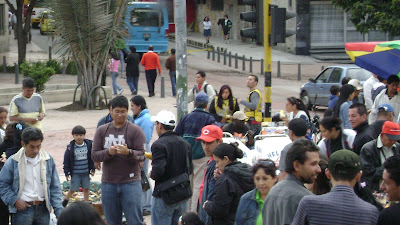 |
| From Colombia: Bogota |
Spot the gringos
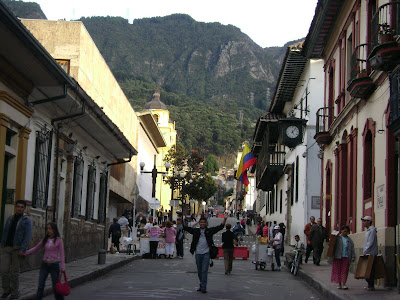 |
| From Colombia: Bogota |
Bogota
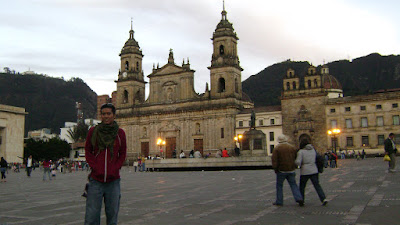 |
| From Colombia: Bogota |
Plaza de Bolivar
Day 2:
Last night we probably did the most gringo thing we could. We took a taxi to the neighborhood around the local university and had 11pm dinner at Bogota Beer Company. We had cheeseburgers, fries, and beer for dinner. And we watched the Red Sox-Rays game on Latin American ESPN.
Woke up this morning around 9am and went to all the places we didn't go to yesterday. Except all the museums we wanted to go to are all randomly closed on Mondays. All the buildings in the colonial district (La Candaleria) are painted in bright colors... red, blue, yellow, green etc. And there's a lot of graffiti everywhere. Some of them are anti-government and support the revolution (Viva Revolucion!) and I've seen a few FARC ones. Hmmm... Also, apparently on Sundays the roads are closed to traffic so we had to deal with crazy Colombian drivers who regard stop signs (Pare) and red lights as suggestions and not rules. David hasn't been hit by a car. Yet. Our cab driver last night just ignored the red lights and sped through. Another observation: locals are not bilingual. They speak Spanish. Just Spanish. Not even a little bit of English to have a small conversation. I haven't used English with a local yet so I've been relying on my Spanish. But then again, after 7 years of Spanish classes my Spanish is still pretty bad. It's true. If you don't use it, you lose it.
Today, went up Monserrate which is the local mountain overlooking the entire city of Bogota. 9300 ft. There was a church at the top and we went to 1pm Mass. It was all in Spanish of course. Colombia is 90% Roman Catholic. And very devout. The main cathedral in Bogota had Opus Dei posters up. The 80th anniversary of OD was just a few weeks ago. Also we walked around the Presidential House, the Colombian White House I guess. Security was tight with dozens of soldiers and police armed with assault rifles every block. Yeah, a lot like Beirut. But at least they don't hate cameras as much as Lebanese soldiers do. We took as many pictures as we wanted. Anyway, we've had enough of the city so we're heading into the Amazon jungle and over to the Caribbean coast for the rest of the week. There's some small towns/villages a few hours north of Bogota, called Tunja and Villa de Leyva. We're taking a $6 dollar bus at 2am so we'll be there in the morning in time for the sunrise. Hasta luego.
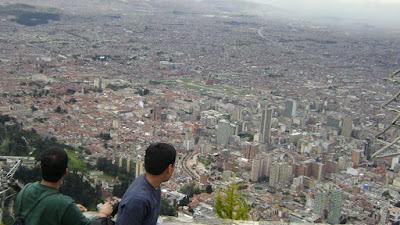 |
| From Colombia: Bogota |
Bogota, 9300 ft.
 |
| From Colombia: Bogota |
 |
| From Colombia: Bogota |
 |
| From Colombia: Bogota |
Viva la revolucion!
Dia Tres:
Last night, checked out of the hostel and after a bit of a delay (David) we made it to Zona Rosa for dinner, an upscale neighborhood in Bogota. Most of it reminded me of Georgetown back home in DC. Expensive restaurants, outdoor bars, brick mansions, malls, etc. Except the houses had barbed wire on the fences. And every block had several fully armed Colombian soldiers in full gear. Hmm...After another late night dinner (Latin American style) at 11pm, we just sat around at a bar (Beer Station) enjoying the nightlife atmosphere and Colombian cerveza. Our last bit of civilization before heading into the countryside.
Left Bogota at 1am on a bus to Tunja. Nicest bus I´ve ever been on. Missed our stop because we fell asleep (the bus was that comfortable). The conductor was actually more worried than we were. Went an hour in the wrong direction. Turned around and got into Tunja around 5am. Took the 6am van to Villa De Leyva. Aldrich and David passed out in the back of the van and missed out on some picturesque scenery through the Andean Mountains and Colombian countryside. Small crosses litter the roadside, marking the spot where someone was killed. They´re everywhere just like in Ecuador. Latin American drivers speed around the winding mountainside roads, just a few feet from the cliffside and a few thousand feet drop. Anyway, got into Villa De Leyva at around 715am.
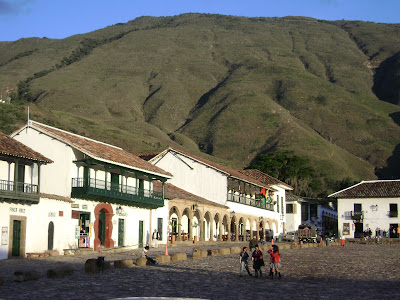
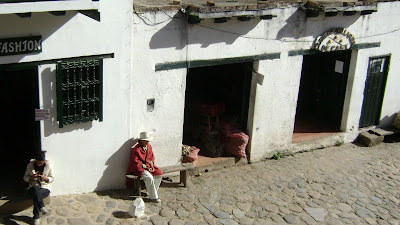
Villa De Leyva is a small town a few hours north of Bogota in the Andes Mountains, which surround the town. Time literally stands still here. There is no modern architecture at all in town. All the colonial-era buildings have been preserved and the town remains mostly unchanged since the early 1600s. The streets are still made of cobble-stones. The church was built in 1608 and hasn´t changed since. The main square is the largest in Colombia. The locals still live mostly simple lives compared to their fellow citizens in the bustling metropolis of Bogota. They´re a lot more friendly too. While Aldrich and David were asleep again after checking into our hotel, that morning I just sat in the main square. Everyone from small children to teenage students to elder couples to stray dogs stopped by to say hello and converse. Didn´t get to far with my Spanish, though.
Strolled through the narrow, cobble-stoned streets for most of the day, just taking in the small colonial town atmosphere. We´ve been doing our best to simulate Latin American culture. We eat small simple breakfasts. Then eat a huge lunch in the afternoon (cheap too, like $5). Then eat dinner around 10 or 11pm. It actually works well. After 2 weeks of doing it in Ecuador, going about 11 or 12 hours without a meal isn´t that bad.
Tonight will probably be a bit quieter than our nights in Bogota. Tomorrow, we´ll try renting out some horses and exploring the countryside outside town ($2 an hour) and then we´ll take the 20 hour bus to Cartagena on the Caribbean coast. Esta de juevos.
 |
| From Colombia: Villa De Leyva |
Plaza Mayor
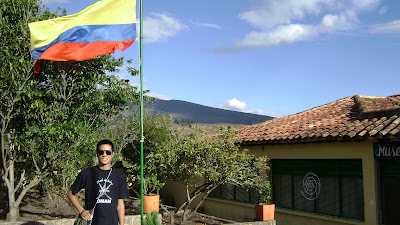 |
| From Colombia: Villa De Leyva |
Colombia
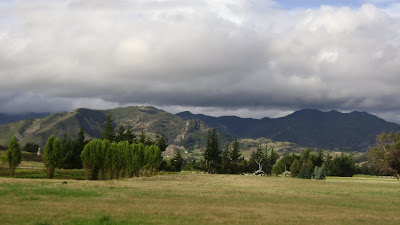 |
| From Colombia: Villa De Leyva |
Andes
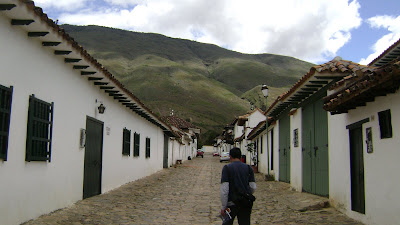 |
| From Colombia: Villa De Leyva |
VDL
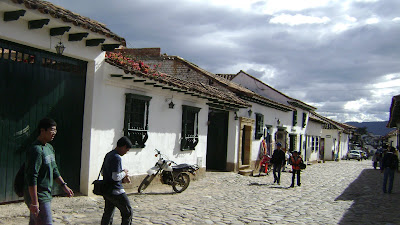 |
| From Colombia: Villa De Leyva |
 |
| From Colombia: Villa De Leyva |
 |
| From Colombia: Villa De Leyva |
locals
 |
| From Colombia: Villa De Leyva |
.50 cent beer and the sunset
Dia Cuatro:
Woke up. Left the hotel. Detained by the Colombian police who thought we were carrying drugs. They asked Aldrich if David was about to cry. I don´t know. Maybe we look like stoners? Or the police are that bored with looking after tourists all day, everyday. If we get stopped again, we´ll just tell them we´re seminarians. Bus back to Tunja. Bus from Tunja to Cartagena. $50. 20 hours. Left at 1230pm. Nicest bus I´ve ever been on. And in South America of all places. Yeah, that´s what I thought at first. Before the bus driver cranked the A/C to full blast the whole time and turned the bus into an icebox. With my jacket and keffiyeh both on, my teeth were still tattering. Movies playing included (in Spanish of course) National Treasure 2, Rush Hour 3, and Zohan (Israeli propaganda...wow). 20 hours on a bus doesn´t sound that bad. If it were on an American highway. But this isn´t America. It´s not even the Middle East. The roads are terrible... full of potholes, bumps, winding turns, only two lanes, with random villagers on the side of the road. I literally counted. The bus could not go more than 10 seconds without hitting a bump. Just like Ecuador. Worst ride of my life. Impossible to sleep or read a book. We´re definitely flying back to Bogota.
At least the scenery was nice, even with the motion sickness. From 9000 ft in the Andean Highlands, we descended all the way to sea level on the Caribbean coast. Very picturesque stuff. The road passes through small villages and towns. It kept reminding me of Ecuador and the Philippines. People just lounging in a plastic chair in front of their concrete house, just watching the traffic go by all day.
Dia Cinco:
Got into Cartagena at 8am. The hostel is in the middle of the old colonial town. $3 a night. The room wasn´t ready until 11am so I just passed out in the tv lounge while the Europeans watched Fox News and debated the US elections. They like Obama. Hmm...
Got lunch around the corner at Restaurante Coronado. $4 for a plate of delicious arroz con pollo y papas fritas con cerveza Colombian. Muy excelente. I can describe the weather here on the Caribbean coast in one word: hot. In two words: hot and sticky. I sweat more sitting down eating at a restaurant here than I do running 6 miles at Notre Dame.
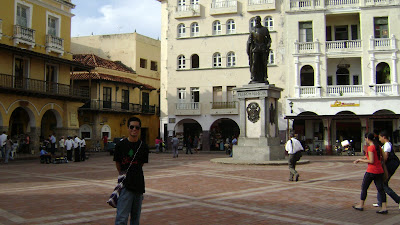
But the 20 hour bus ride and the mucho calor weather make this old colonial town on the Caribbean coast the highlight of any trip to Colombia, or maybe even to South America. Founded in the 16th century, Cartagena was the jewel of the global Spanish empire as it was the gateway to South America and the main port in the New World. It was here that the conquistadors shipped all their plundered Indian gold back to Europe. It was here that pirates such as Sir Francis Drake sacked the port for booty. Located on the coast, there are a lot more blacks here than in the Andes mountains. The descendents of African slaves brought here in the colonial period, they´ve created a distinct Creole culture distinctive from the culture of the mountainous regions. Today the town is famous for perfectly preserving its colonial architecture in the old town. We walked around the old town all day, just admiring the simple but inspiring colonial buildings, with bright colors and balconies overlooking the narrow streets. It reminds me of Jerusalem. People can just walk freely in the streets without the noise and disruption that traffic brings. Street vendors sell delicious local snacks (empanadas) and fake Cuban cigars. Streetlife is what makes Cartagena special. Musicans play vallenato on the corners. Horse-drawn carriages and mules walk through the streets, a reminder of the old colonial days.
At night when the sun goes down is when the place really comes alive. Local dancers perform in the square. Outdoor cafes and restaurants in open plazas reminisce of old Europe. But this isn´t Europe. It´s Colombia. The best difference is that you won´t go broke paying for everything here.
We did meet a Jesuit priest here at Iglesia San Pedro Clover, the first to be canonized in the New World. Aldrich had a long conversation with him in Spanish while I tried to follow along. He did mention Opus Dei, at which point I told him in Spanish that I lived in an Opus Dei Center in the US. Apparently he considers Opus Dei an "enemy" of the Jesuits, whatever that means. Maybe something got lost in translation.
Anyway, we had dinner at this outdoor restaurant in one of the open squares. There was a group of Creoles dancing to their tribal-like music. But they were dressed in Spanish clothing. And they speak Spanish too of course. Blending of cultures. We went into this supermarket afterwards and David managed to get separated from us. We lost him. In a sketch part of town. In the middle of a foreign city. In Colombia. We found him later though.
 |
| From Colombia: Cartagena, Caribbean Coast |
Cartagena
 |
| From Colombia: Cartagena, Caribbean Coast |
 |
| From Colombia: Cartagena, Caribbean Coast |
 |
| From Colombia: Cartagena, Caribbean Coast |
 |
| From Colombia: Cartagena, Caribbean Coast |
Dia Seis:
Woke up to a loud Colombian man yelling "Newspapers!" every few seconds at 7am. David punched me in the back while sleeping. He snores so loud. Bought airline tickets at a travel agency. $150 one way Cartagena to Bogota. Expensive but definitely better than 20 hours on the bus ride from hell. Took a cab to the Castillo de San Felipe, built in the early 1600s. The strongest and most formidable fortress ever built by the Spanish Empire. Cartagena was that important to Spain and her empire. If they lost Cartagena, they could´ve lost the entire continent or the whole Caribbean. The fortress was the first of its kind, implementing innovating military engineering. Maybe that´s why the fortress was never captured despite numerous attempts to storm it, by pirates, the English, and local Indian tribes. This is also why Cartagena was the last South American city to receive independence from Spain.
Ran into some old guy named Raymundo who offered to take us around Bogota for 30,000 pesos. After some deliberation, we accepted and he drove us the the highest hill in the city. At the top was the Conventa de la Popa, or Convent of the Stern. Apparently the hill looks like the back end of a ship. Founded in 1607 by the Augustine Padres, the hill overlooks the entire city. Buena Vista. After driving around the city a bit more, he dropped us off at the beach. My first time in the Caribbean. The water was warm. It was a bit cloudy but it was sunset so it was muy bueno. Too bad there were more vendors at the beach than actual tourists. For the first 20 minutes we literally had at least 2 to 4 vendors surrounding our tent trying to sell us stuff. I didn´t buy anything. Just a beer for 50 cents. Aldrich got a massage and some fresh crabs. He paid them in American dollars. It´s a wonder what a few dollar bills can do for the locals. They were amazed. Maybe it made them feel American. A bit.
So, our last night in Colombia. Walked around the old city some more and stumbled upon a fiesta in the streets. A live band and salsa music were playing. Women in local costumes danced on stage. Alcohol everywhere. Everywhere. It was drizzling. No one cared. Soldiers and police looked on. Everyone was dancing in the streets. Even the vendors. No one cared. Alcohol everywhere. Friday night in the Caribbean. Everyone just wanted to have a good time. Too bad David got pickpocketed. What a gringo.
Had the usual late night dinner (10pm) at an outdoor restaurant in Plaza de Santo Domingo. Great place for people-watching. We ordered lobster. We were on the Caribbean. Aldrich and I got wine. I got a plate of pasta with some lobster for $14.50. Aldrich and David weren´t too pleased with their dish of lobster. It looked more like art than food. They literally stared at it for a few minutes before finally eating. We sat there past midnight just taking in the aura of the local atmosphere. It felt like a typical outdoor restaurant in an open square in Italy or France. Except mariachi bands played around us. Vendors stopped at our table. I messed with them a bit, as usual. Fun stuff.
Dia Siete:
Our last day in Colombia. Flew back to Bogota this morning at 1039am. Got in before noon. Yeah, that was a lot better than the bus. It only took an hour. The seats were leather. Most of the people on the plane were upper-class. Maybe that´s why the receptionist at the hostel was so surprised when we told her we were flying back. Here we are paying $7 a night and eating $1 fried chicken with potato meals next door but then we shell out $150 for a one hour plane flight. Hmm...
Walked around the same places as before when we got back in the old town. I drank a beer earlier in the main plaza. I love South America. Running out of money, I bought a cowboy hat. The only thing I bought in Colombia this week.
We managed to watch the Notre Dame game here in Bogota too. Just went to the most American place we could find, TGIF's. We didn't want to play the obnoxious Americanos and do the cheers but we were probably the only ones in the place watching the game. The game was on every TV in the restaurant.
Flight at 1220am. Barely made it. Like Ecuador, Colombia slams you with a random departure tax of $25, only payable in cash. Like all my other trips, it's good to be back at school after living as much a spartan lifestyle as I could. From brutal 20 hour bus rides through the jungle to staying in the cheapest hostels we could find to $1 dollar meals, the real value of traveling with a backpacker's mentality is that when you do return to civilization you're not in as much withdrawal as you would if you went 5-star all the way. As usual the first thing I did when I got home was sleep in my bed, the only real mattress I've slept on all week. It's strange. The week went by pretty fast. One week I'm stressed with college. The next week I'm totally free from any burdens and can do whatever I want in Colombia. Then the next week it's back to college. Only one more month until Thanksgiving at least.
I'll miss Colombia. I'm sure I'll return one day, since we did not see as much of the country we could have if we had more time. Like all the countries I visited in the Middle East, the only perception I had coming into Colombia was the caricature painted by the media and State Department. All I ever heard of Colombia was about kidnappings, assassinations, drug lords, political violence, drugs, murder, extortion, crime, war, shootings, etc. The State Dept. says that Americans definitely should not travel on buses and should not travel at night. We did anyway. According to the State Dept. Colombia is the "most dangerous country in the Western Hemisphere." And like all my previous visits to "dangerous" countries, I was able to see the country for what it really was. Not through the eyes of the media or government. And what I saw was a charming South American country and a must-see for travelers. Like Lebanon, the place is heavily militarized but all the perceptions of danger and instablity actually make it even more attractive to travelers because there's less hordes of other tourists to deal with. As long as you know how to travel and use common sense, you're fine. DC and NYC have worse crime rates than Bogota and Cartagena. Don't believe the stereotypes. You're just missing out. Go to Colombia.
Viva Colombia!
Colombia Fun Facts:
The only South American country with coasts on both the Atlantic and Pacific Oceans.
Produces 90% of the world's cocaine.
90% Roman Catholic.
#1 Exporter of flowers.
#2 Exporter of coffee.
Named after Christopher Colombus, though he never set foot there.
Most dangerous country in the Western Hemisphere, according to the US State Dept.
President Uribe is the most pro-US leader in Latin America.
September 30, 2008
Israel/Palestine
"Welcome to Occupied Palestine. Enjoy your stay."
http://www.new.facebook.com/album.php?aid=2014527&l=2d0b0&id=1092690461
I volunteered at a Palestinian Refugee Camp outside Bethlehem for two weeks to rebuild the home to a Christian Palestinian family whose home was bulldozed illegally a year ago by the Israelis.
Dome of the Rock in Jerusalem. 3rd Holiest Site in Islam. Where the Prophet Muhammad ascended to Heaven.
Western Wall in Jerusalem. Holiest Site of Judaism. The only remains of the 2nd Temple.
Church of the Holy Sepulchre. Holiest site in Christianity. Where Christ was crucified, buried, and resurrected.
I crossed the border into the Palestinian West Bank from Amman in Jordan. After the ordeal in Jordan, things didn't get any easier at the border. Although the West Bank is not part of Israel, the Israelis occupy it and control the borders. Palestinians have no control over their borders. After being held at the border by the Israelis for 7 hours (they didn't like my visa stamps from Iran/Syria/Lebanon or the Hezbollah stuff in my bag), I took a bus to Jerusalem and then another bus to Bethlehem to start my aid work at a refugee camp just outside town. The whole ordeal took 12 hours from Amman to Bethlehem, due to the Israelis tight security measures.
The US State Department warns Americans to avoid all travel in the West Bank. I went anyway.
Entering the West Bank, on my way to Jerusalem it was impossible to miss the huge concrete wall being built to separate Israel and the West Bank. On the Israeli side, the landscape looks like Southern Europe. On the Palestinian side, it looks like your basic third world country under military occupation. 95% of the wall is in Palestine and does not adhere to the 1967 borders. Crippling the Palestinian economy and stealing more land from the Palestinians, the UN and International Court in the Hague have called the wall illegal. Meanwhile, the US just gives more money to Israel to build it. 2.5 billion dollars a year. Racism, destruction, human rights violations, illegal occupation, and apartheid are paid for by American taxpayers.
"Opponents argue that the barrier is an illegal attempt to annex Palestinian land under the guise of security, violates international law, has the intent or effect to pre-empt final status negotiations, and severely restricts Palestinians who live nearby, particularly their ability to travel freely within the West Bank and to access work in Israel. In a 2004 decision, the International Court of Justice declared construction of the wall "contrary to international law."
In 2004, the United Nations passed a number of resolutions and the International Court of Justice, following hearings in which Israel did not participate, issued an advisory opinion calling for the barrier to be removed and the Arab residents to be compensated for any damage done: "The Court finds that the construction by Israel of a wall in the Occupied Palestinian Territory and its associated régime are contrary to international law"
The Red Cross has declared the barrier in violation of the Geneva Convention. On February 18, 2004, The International Committee of the Red Cross stated that the Israeli barrier "causes serious humanitarian and legal problems" and goes "far beyond what is permissible for an occupying power".
Amnesty International, Human Rights Watch and other Human rights groups have protested both the routing of the wall and the means by which the land to build the wall was obtained."
I spent two weeks rebuilding a house for a Christian Palestinian family. Their old house in the village was in the way of the Israeli wall under construction so the Israeli Army just demolished it. The family of 7 had been living in a tent for more than a year.
"Holy Land Trust’s Home Rebuilding Camp has been hard at work rebuilding the home of Walid Ahour, which was destroyed by the Israeli military in 2005. About fifteen international volunteers from Europe and the US are working side by side with Palestinian builders to build a new house in just two weeks. After three days of building, all four walls were already set up. On the fourth day, huge cement trucks made their way to the tiny village to pour concrete for the roof. We had a special lunch of sheep meat to celebrate this milestone—finally Walid’s family will have their own roof over their heads!
The family keeps the volunteers well-fed with delicious homemade lunches, fresh fruits and vegetables from the garden, and endless supplies of coffee and tea. The volunteers have enjoyed practicing their Arabic with the many children, cousins, and friends who come to watch the building. The atmosphere at the site is more like a party than a construction site—the female volunteers were even invited into the house for a spontaneous dance party with some women from the village.
Today the house is finished thanks for all the volunteers who joined us hand in hand to build the house , thanks for everyone who gave his time , his support to this just cause , thanks for the villagers that worked with us , and thanks for all the donations from different parts of the world. Right now Holy Land Trust is getting prepared for the next year’s summer camp , so hopefully soon we will have information about the 2009 Summer Camp and we are all getting very excited to handle the key of another house to a new family."
Meanwhile, across the valley rich, militant Israeli settlers live in their illegal million dollar homes. Palestinians live in crap cinder block houses and the Israelis build these million dollar homes on Palestinian land.
The 1994 Shamgar Commission of Inquirery concluded that Israeli authorities have consistently failed to investigate or prosecute crimes committed by settlers against Palestinians. According to Human Rights Watch, the settler bias of the IDF was confirmed and clarified by Hebron commander Noam Tivon.
"A number of international bodies, including the United Nations Security Council, the International Court of Justice, the European Union, Amnesty International and Human Rights Watch and many legal scholars have characterized the settlements as a violation of international law."
In a 2004 report Amnesty International wrote that "The fence/wall, in its present configuration, violates Israel’s obligations under international humanitarian law."
They continue:
"Since the summer of 2002 the Israeli army has been destroying large areas of Palestinian agricultural land, as well as other properties, to make way for a wall which it is building in the West Bank. In addition to the large areas of particularly fertile Palestinian farmland that have been destroyed, other larger areas have been cut off from the rest of the West Bank by the wall. The wall is not being built between Israel and the Occupied Territories but mostly (close to 90%) inside the West Bank, turning Palestinian towns and villages into isolated enclaves, cutting off communities and families from each other, separating farmers from their land and Palestinians from their places of work, education and health care facilities and other essential services. This in order to facilitate passage between Israel and more than 50 illegal Israeli settlements located in the West Bank.
In October 2003, a United Nations resolution to declare the barrier illegal where it deviates from the green line and should be torn down was vetoed by the US in the United Nations Security Council. In December 2003, it was accepted by the United Nations General Assembly (with four votes against). Consequently, the International Court of Justice was asked for an advisory opinion. It concluded that the barrier violated international law. On 20 July 2004, the UN General Assembly accepted another resolution condemning the barrier with 150 countries voting for the resolution. Only 6 countries voted against: Israel, the US, Australia, Micronesia, the Marshall Islands and Palau. The US and Israel rejected both the verdict and the resolution. All 25 members of the European Union voted in favour of the resolution after it was amended to include calls for Israelis and Palestinians to meet their obligations under the "roadmap" peace plan."
The US State Department warns Americans to avoid any demonstrations in the West Bank. I went anyway. A group of Palestinians were protesting the illegal wall and the IDF's military occupation at a checkpoint outside Bethlehem, one of many in the Occupied West Bank that serves to enforce Israel's apartheid system and limit the Palestinian's freedom of movement.
Then IDF reinforcements showed up. Although the US revokes an American's citizenship if they serve in a foreign military, if an American serves in the Israeli Army they can still retain their citizenship. the Israel Army is the only exception.
Israeli has violated more UN Resolutions (more than 200 in its 60 year history) and Geneva Conventions than any other country in the world. Israel's human rights record is also one of world's worst.
The UN report on the subject noted: "It was not only the Palestinian people whose movement was restricted during Operation Defensive Shield in 2004. In many instances, humanitarian workers were not able to reach people in need to assess conditions and deliver necessary assistance because of the sealing of cities, refugee camps and villages during the operation. There were also cases of Israeli forces not respecting the neutrality of medical and humanitarian workers and attacking ambulances."
Human Rights Watch determined that "Israeli forces committed serious violations of international humanitarian law, some amounting prima facie to war crimes."
Amnesty International reported that war crimes occurred in the Jenin refugee camp and in Nablus, including: unlawful killings; a failure to ensure medical or humanitarian relief; demolition of houses and property occurred (sometime with civilians still inside); water and electricity supplies to civilians were cut; torture or other cruel, inhuman or degrading treatment in arbitrary detention occurred; and Palestinians civilians were used for military operations or as "human shields." According to Amnesty, "the IDF acted as though the main aim was to punish all Palestinians." Collective punishment is outlawed by the Fourth Geneva Convention.
Living in Bethlehem for the two weeks, I had the privilege of being able to visit the Church of the Nativity, the site of Jesus's birthplace and damaged in 2002 by the Israelis, who left many bullet holes on the church.
"From March to April 2002, the Israeli Defense Forces (IDF) carried out “Operation Defensive Shield” in the West Bank. As a part of these large-scale military operations, Bethlehem was advanced upon in a declared effort to root out militants. On April 1, 2002, Israeli tanks surrounded Bethlehem. The next day, Israeli military planes, tanks and troops entered the city, sparking heavy criticism due to the sensitive nature of the site. Approximately 200 Palestinians--including a number of militants--fled the advancing Israeli forces into the Church of the Nativity. During the siege, the Church bell-ringer and nine Palestinians inside the Church were killed and many more wounded by the IDF. A Franciscan monk was also killed in his residence by IDF indirect fire during the siege. By early May, Bethlehem was the last West Bank city where the Israeli forces were still present in the wake of “Operation Defensive Shield.” A large fire was accidentally started during the siege. According to a PBS documentary, an IDF flare was responsible."
a lot of this Christian town has been destroyed and/or bombed out during the second intifada (2000 - present) by the Israelis. not exactly the cozy Middle Eastern village you see on Christmas cards
"On April 1, 2002, after an Israeli air attack, Israeli tanks surrounded Bethlehem. The next day, Israeli tanks and troops entered the city. In early May, Bethlehem was the last West Bank city where Israeli forces were still present in the wake of “Operation Defensive Shield”. They left only after the full attack, siege, and evacuation of the Church of the Nativity, which was the scene of a stand-off between the Israeli army and a group of Palestinians who had taken refuge inside the Church."
I also made my way to Hebron, south of Bethlehem and a major flash point of the Palestinian-Israeli conflict. My travel book said to not go to Hebron. I went anyway.
Israeli snipers occupy the roofs to most buildings in town and militant Israeli settlers have seized land belonging to Palestinians. Also in town is the Cave of the Patriarchs. Split between the Muslims (who call it the Ibrahami Mosque) and Jews, it is the second holiest site for Jews (after the Temple Mount in Jerusalem) and is also venerated by Christians whose traditions maintain that the site is the burial place of four Biblical couples: (1) Adam and Eve; (2) Abraham and Sarah; (3) Isaac and Rebekah; (4) Jacob and Leah. On our way out, an IDF infantry squad arrested a group of Palestinians in the market. Typical.
I also went to Jericho. Oldest city in the world (10,000 years). Also the lowest city in the world (260m below sea level). And the first city conquered by the Israelites when they first entered Canaan (Joshua and his army's 7 circuits and trumpets). In town was the Zacchaeus Tree, the tree Zacchaeus climbed for a better view of Jesus preaching (Luke 19:1-10). On the outskirts of town I ascended the Mount of Temptation. After fasting for 40 days, it was here that Jesus was tempted by Satan. Further outside town were the shores of the Dead Sea, the lowest point on Earth (400m below sea level) and where Sodom and Gomorrah were located. It is impossible to sink in the Dead Sea. With such high levels of salt, you just float on top. you could fall asleep and nap if you wanted to. It's called the Dead Sea because the high levels of salt prevent any kind of marine life.
Jerusalem
The most holiest, most beautiful, most historic, and most disputed city in human history.
Israel may claim it as their capital but the UN and the majority of the international community refuse to recognize it as Israel's capital. The US recognizes it as Israel's capital. Go figure.
The Israelis' illegal wall separates Muslim East Jerusalem from the West Bank. Coming from Bethlehem in the Palestinian West Bank, it takes Palestinians (and me) over an hour to get to Jerusalem as we go through 4 different IDF checkpoints. Israelis have their own private highway and takes about 10 minutes to get to Jerusalem. Hmmm...
http://www.new.facebook.com/album.php?aid=2014527&l=2d0b0&id=1092690461
The Golan Heights
http://www.new.facebook.com/album.php?aid=2014527&l=2d0b0&id=1092690461
Israel
http://www.new.facebook.com/album.php?aid=2014968&l=08f0b&id=1092690461
I'll be returning to Israel and Palestine this January for three weeks. Hopefully this time I'll be able to get into Gaza. I'm still not sure if I'll write my thesis on the Israeli-Palestinian conflict or on Hezbollah, but it's going to be related to the Israeli-Arab conflict in some way. And it has to be at least 40 pages long.
Free Palestine.
http://www.new.facebook.com/album.php?aid=2014527&l=2d0b0&id=1092690461
I volunteered at a Palestinian Refugee Camp outside Bethlehem for two weeks to rebuild the home to a Christian Palestinian family whose home was bulldozed illegally a year ago by the Israelis.
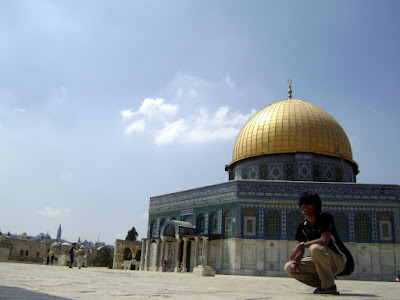 |
| From Jerusalem |
Dome of the Rock in Jerusalem. 3rd Holiest Site in Islam. Where the Prophet Muhammad ascended to Heaven.
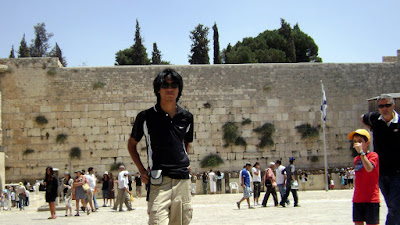 |
| From Jerusalem |
Western Wall in Jerusalem. Holiest Site of Judaism. The only remains of the 2nd Temple.
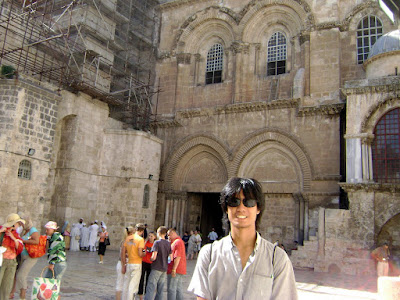 |
| From Jerusalem |
Church of the Holy Sepulchre. Holiest site in Christianity. Where Christ was crucified, buried, and resurrected.
I crossed the border into the Palestinian West Bank from Amman in Jordan. After the ordeal in Jordan, things didn't get any easier at the border. Although the West Bank is not part of Israel, the Israelis occupy it and control the borders. Palestinians have no control over their borders. After being held at the border by the Israelis for 7 hours (they didn't like my visa stamps from Iran/Syria/Lebanon or the Hezbollah stuff in my bag), I took a bus to Jerusalem and then another bus to Bethlehem to start my aid work at a refugee camp just outside town. The whole ordeal took 12 hours from Amman to Bethlehem, due to the Israelis tight security measures.
The US State Department warns Americans to avoid all travel in the West Bank. I went anyway.
Entering the West Bank, on my way to Jerusalem it was impossible to miss the huge concrete wall being built to separate Israel and the West Bank. On the Israeli side, the landscape looks like Southern Europe. On the Palestinian side, it looks like your basic third world country under military occupation. 95% of the wall is in Palestine and does not adhere to the 1967 borders. Crippling the Palestinian economy and stealing more land from the Palestinians, the UN and International Court in the Hague have called the wall illegal. Meanwhile, the US just gives more money to Israel to build it. 2.5 billion dollars a year. Racism, destruction, human rights violations, illegal occupation, and apartheid are paid for by American taxpayers.
"Opponents argue that the barrier is an illegal attempt to annex Palestinian land under the guise of security, violates international law, has the intent or effect to pre-empt final status negotiations, and severely restricts Palestinians who live nearby, particularly their ability to travel freely within the West Bank and to access work in Israel. In a 2004 decision, the International Court of Justice declared construction of the wall "contrary to international law."
In 2004, the United Nations passed a number of resolutions and the International Court of Justice, following hearings in which Israel did not participate, issued an advisory opinion calling for the barrier to be removed and the Arab residents to be compensated for any damage done: "The Court finds that the construction by Israel of a wall in the Occupied Palestinian Territory and its associated régime are contrary to international law"
The Red Cross has declared the barrier in violation of the Geneva Convention. On February 18, 2004, The International Committee of the Red Cross stated that the Israeli barrier "causes serious humanitarian and legal problems" and goes "far beyond what is permissible for an occupying power".
Amnesty International, Human Rights Watch and other Human rights groups have protested both the routing of the wall and the means by which the land to build the wall was obtained."
I spent two weeks rebuilding a house for a Christian Palestinian family. Their old house in the village was in the way of the Israeli wall under construction so the Israeli Army just demolished it. The family of 7 had been living in a tent for more than a year.
"Holy Land Trust’s Home Rebuilding Camp has been hard at work rebuilding the home of Walid Ahour, which was destroyed by the Israeli military in 2005. About fifteen international volunteers from Europe and the US are working side by side with Palestinian builders to build a new house in just two weeks. After three days of building, all four walls were already set up. On the fourth day, huge cement trucks made their way to the tiny village to pour concrete for the roof. We had a special lunch of sheep meat to celebrate this milestone—finally Walid’s family will have their own roof over their heads!
The family keeps the volunteers well-fed with delicious homemade lunches, fresh fruits and vegetables from the garden, and endless supplies of coffee and tea. The volunteers have enjoyed practicing their Arabic with the many children, cousins, and friends who come to watch the building. The atmosphere at the site is more like a party than a construction site—the female volunteers were even invited into the house for a spontaneous dance party with some women from the village.
Today the house is finished thanks for all the volunteers who joined us hand in hand to build the house , thanks for everyone who gave his time , his support to this just cause , thanks for the villagers that worked with us , and thanks for all the donations from different parts of the world. Right now Holy Land Trust is getting prepared for the next year’s summer camp , so hopefully soon we will have information about the 2009 Summer Camp and we are all getting very excited to handle the key of another house to a new family."
Meanwhile, across the valley rich, militant Israeli settlers live in their illegal million dollar homes. Palestinians live in crap cinder block houses and the Israelis build these million dollar homes on Palestinian land.
The 1994 Shamgar Commission of Inquirery concluded that Israeli authorities have consistently failed to investigate or prosecute crimes committed by settlers against Palestinians. According to Human Rights Watch, the settler bias of the IDF was confirmed and clarified by Hebron commander Noam Tivon.
"A number of international bodies, including the United Nations Security Council, the International Court of Justice, the European Union, Amnesty International and Human Rights Watch and many legal scholars have characterized the settlements as a violation of international law."
In a 2004 report Amnesty International wrote that "The fence/wall, in its present configuration, violates Israel’s obligations under international humanitarian law."
They continue:
"Since the summer of 2002 the Israeli army has been destroying large areas of Palestinian agricultural land, as well as other properties, to make way for a wall which it is building in the West Bank. In addition to the large areas of particularly fertile Palestinian farmland that have been destroyed, other larger areas have been cut off from the rest of the West Bank by the wall. The wall is not being built between Israel and the Occupied Territories but mostly (close to 90%) inside the West Bank, turning Palestinian towns and villages into isolated enclaves, cutting off communities and families from each other, separating farmers from their land and Palestinians from their places of work, education and health care facilities and other essential services. This in order to facilitate passage between Israel and more than 50 illegal Israeli settlements located in the West Bank.
In October 2003, a United Nations resolution to declare the barrier illegal where it deviates from the green line and should be torn down was vetoed by the US in the United Nations Security Council. In December 2003, it was accepted by the United Nations General Assembly (with four votes against). Consequently, the International Court of Justice was asked for an advisory opinion. It concluded that the barrier violated international law. On 20 July 2004, the UN General Assembly accepted another resolution condemning the barrier with 150 countries voting for the resolution. Only 6 countries voted against: Israel, the US, Australia, Micronesia, the Marshall Islands and Palau. The US and Israel rejected both the verdict and the resolution. All 25 members of the European Union voted in favour of the resolution after it was amended to include calls for Israelis and Palestinians to meet their obligations under the "roadmap" peace plan."
The US State Department warns Americans to avoid any demonstrations in the West Bank. I went anyway. A group of Palestinians were protesting the illegal wall and the IDF's military occupation at a checkpoint outside Bethlehem, one of many in the Occupied West Bank that serves to enforce Israel's apartheid system and limit the Palestinian's freedom of movement.
Then IDF reinforcements showed up. Although the US revokes an American's citizenship if they serve in a foreign military, if an American serves in the Israeli Army they can still retain their citizenship. the Israel Army is the only exception.
Israeli has violated more UN Resolutions (more than 200 in its 60 year history) and Geneva Conventions than any other country in the world. Israel's human rights record is also one of world's worst.
The UN report on the subject noted: "It was not only the Palestinian people whose movement was restricted during Operation Defensive Shield in 2004. In many instances, humanitarian workers were not able to reach people in need to assess conditions and deliver necessary assistance because of the sealing of cities, refugee camps and villages during the operation. There were also cases of Israeli forces not respecting the neutrality of medical and humanitarian workers and attacking ambulances."
Human Rights Watch determined that "Israeli forces committed serious violations of international humanitarian law, some amounting prima facie to war crimes."
Amnesty International reported that war crimes occurred in the Jenin refugee camp and in Nablus, including: unlawful killings; a failure to ensure medical or humanitarian relief; demolition of houses and property occurred (sometime with civilians still inside); water and electricity supplies to civilians were cut; torture or other cruel, inhuman or degrading treatment in arbitrary detention occurred; and Palestinians civilians were used for military operations or as "human shields." According to Amnesty, "the IDF acted as though the main aim was to punish all Palestinians." Collective punishment is outlawed by the Fourth Geneva Convention.
Living in Bethlehem for the two weeks, I had the privilege of being able to visit the Church of the Nativity, the site of Jesus's birthplace and damaged in 2002 by the Israelis, who left many bullet holes on the church.
"From March to April 2002, the Israeli Defense Forces (IDF) carried out “Operation Defensive Shield” in the West Bank. As a part of these large-scale military operations, Bethlehem was advanced upon in a declared effort to root out militants. On April 1, 2002, Israeli tanks surrounded Bethlehem. The next day, Israeli military planes, tanks and troops entered the city, sparking heavy criticism due to the sensitive nature of the site. Approximately 200 Palestinians--including a number of militants--fled the advancing Israeli forces into the Church of the Nativity. During the siege, the Church bell-ringer and nine Palestinians inside the Church were killed and many more wounded by the IDF. A Franciscan monk was also killed in his residence by IDF indirect fire during the siege. By early May, Bethlehem was the last West Bank city where the Israeli forces were still present in the wake of “Operation Defensive Shield.” A large fire was accidentally started during the siege. According to a PBS documentary, an IDF flare was responsible."
a lot of this Christian town has been destroyed and/or bombed out during the second intifada (2000 - present) by the Israelis. not exactly the cozy Middle Eastern village you see on Christmas cards
"On April 1, 2002, after an Israeli air attack, Israeli tanks surrounded Bethlehem. The next day, Israeli tanks and troops entered the city. In early May, Bethlehem was the last West Bank city where Israeli forces were still present in the wake of “Operation Defensive Shield”. They left only after the full attack, siege, and evacuation of the Church of the Nativity, which was the scene of a stand-off between the Israeli army and a group of Palestinians who had taken refuge inside the Church."
I also made my way to Hebron, south of Bethlehem and a major flash point of the Palestinian-Israeli conflict. My travel book said to not go to Hebron. I went anyway.
Israeli snipers occupy the roofs to most buildings in town and militant Israeli settlers have seized land belonging to Palestinians. Also in town is the Cave of the Patriarchs. Split between the Muslims (who call it the Ibrahami Mosque) and Jews, it is the second holiest site for Jews (after the Temple Mount in Jerusalem) and is also venerated by Christians whose traditions maintain that the site is the burial place of four Biblical couples: (1) Adam and Eve; (2) Abraham and Sarah; (3) Isaac and Rebekah; (4) Jacob and Leah. On our way out, an IDF infantry squad arrested a group of Palestinians in the market. Typical.
I also went to Jericho. Oldest city in the world (10,000 years). Also the lowest city in the world (260m below sea level). And the first city conquered by the Israelites when they first entered Canaan (Joshua and his army's 7 circuits and trumpets). In town was the Zacchaeus Tree, the tree Zacchaeus climbed for a better view of Jesus preaching (Luke 19:1-10). On the outskirts of town I ascended the Mount of Temptation. After fasting for 40 days, it was here that Jesus was tempted by Satan. Further outside town were the shores of the Dead Sea, the lowest point on Earth (400m below sea level) and where Sodom and Gomorrah were located. It is impossible to sink in the Dead Sea. With such high levels of salt, you just float on top. you could fall asleep and nap if you wanted to. It's called the Dead Sea because the high levels of salt prevent any kind of marine life.
Jerusalem
The most holiest, most beautiful, most historic, and most disputed city in human history.
Israel may claim it as their capital but the UN and the majority of the international community refuse to recognize it as Israel's capital. The US recognizes it as Israel's capital. Go figure.
The Israelis' illegal wall separates Muslim East Jerusalem from the West Bank. Coming from Bethlehem in the Palestinian West Bank, it takes Palestinians (and me) over an hour to get to Jerusalem as we go through 4 different IDF checkpoints. Israelis have their own private highway and takes about 10 minutes to get to Jerusalem. Hmmm...
http://www.new.facebook.com/album.php?aid=2014527&l=2d0b0&id=1092690461
The Golan Heights
http://www.new.facebook.com/album.php?aid=2014527&l=2d0b0&id=1092690461
Israel
http://www.new.facebook.com/album.php?aid=2014968&l=08f0b&id=1092690461
I'll be returning to Israel and Palestine this January for three weeks. Hopefully this time I'll be able to get into Gaza. I'm still not sure if I'll write my thesis on the Israeli-Palestinian conflict or on Hezbollah, but it's going to be related to the Israeli-Arab conflict in some way. And it has to be at least 40 pages long.
Free Palestine.
September 04, 2008
Jordan
I was only supposed to be in Jordan for an hour, or the time it takes to take a bus from the airport outside Amman (the capital) to the border with the Palestinian West Bank (NOT Israel). The West Bank is not part of Israel; it is controlled and occupied by Israel. From the border I would take a bus to Jerusalem then another bus to Bethlehem. I was to leave Beirut at sunrise and be in Bethlehem by sunset. It ended up taking me over 36 hours to go 93 miles thanks to the geopolitical implications of the Middle East. After my 6 weeks of study in Lebanon, I had volunteered as an aid worker at a Palestinian refugee camp outside Bethlehem in the Israeli-occupied Palestinian West Bank. My aid work would last two weeks and then I would fly straight back to Notre Dame. Since Israel and Lebanon are at war there was no direct way to get to Beirut to Bethlehem. My only option was to fly to Amman and crossover into the West Bank by land. Beirut to Amman to Jerusalem to Bethlehem.
I left my apartment in Beirut at 5am and had a bittersweet goodbye to Lebanon as the sun was rising over the mountains to the west. I landed in Amman on time 45 minutes after takeoff. Turns out there are no buses to the border but only to Amman. This wouldn't be too much of a delay since Amman is on the way to the border anyway. I got to Amman and negotiated a fare with a taxi driver to take me straight to the border. I looked in my travel book after we left and it turns out I overpaid him by 10 dinars but whatever; I just wanted to get to Bethlehem. We get to the border 45 minutes later and to my luck it was closed. I never found out why, but borders around Israel and Palestine are prone to random closures at the hint of the smallest security threat. Great. The Israelis were being uptight Jews as usual. The border wouldn't reopen til the next morning. I tried to argue with the taxi driver (Arabic of course) to give me a discount since he was driving back to Amman anyway, border open or closed. He only relented when I told him I was a poor minority college student. So we got back to Amman and I had to find a hotel. I found a great place downtown thanks to my travel book. So I inadvertently ended up with time to explore Amman, capital of the Hashemite Kingdom of Jordan.
After visiting the great Arab capitals of antiquity, Damascus in Syria and Cairo in Egypt, Amman in Jordan doesn't really impress. It has its fair share of old Roman/Byzantium sights and ruins but they really don't compare. Amman itself is fairly Westernized and modern... but unlike Beirut there's no character to the place. Amman to me, at least after all my travels in the Mideast, seemed generic and bland. Nice but nothing special. Central and South Jordan, on the other hand, is where it's at and is actually probably the 2nd most visited tourist spot in the Middle East. I was confined to the capital since I needed to get to Palestine so I'd have to save trips to those regions for another time. News reporters put it best when they nicknamed the country, "The Hashemite Kingdom of Boredom." But on a more positive note, besides the aforementioned connotation of that nickame, Jordan is widely known as the most stable country in the entire Middle East. The royal family (who claims descendency from the Prophet Muhammad) enjoys widespread support, both from Jordanians and from the West, for its wise handling of various crises throughout Jordanian history that threatened the peace and stability of the nation (1948 War, 1967 War, Black September 1970-1, 1973 War, Gulf War 1990-1, Peace with Israel 1994, Al-Qaeda bombings 2005, etc.)
Anyway I left Amman early the next morning and got to the border. I wasn't surprised to see it full of Arab families trying to get into Palestine. The border is controlled by the Israelis even though the West Bank wasn't annexed by Israel in 1967. Palestinians have no control over their borders; just one of the results of living under occupation. It took me 7 hours to cross the border. The Israelis didn't like my visa stamps from Iran/Syria/Lebanon or my Hezbollah stuff in my bag. They took me into a separate room and questioned me twice. The UN imposed a demilitarized zone between the two nations because although the Jordanians signed a peace agreement with Israel in 1994 (probably under large US pressure, who is a strong ally with Jordan), it doesn't exactly mean they no longer harbor bitterness towards Israel's existence or its human rights violations of Palestinians. Peace in this context simply just means the absence of war, or as Ambrose Bierce put it, "in international affairs, [peace is] a period of cheating between two periods of fighting."
Roman ruins in Amman
King Abdullah II, at the border with Palestine (The Occupied West Bank)
I left my apartment in Beirut at 5am and had a bittersweet goodbye to Lebanon as the sun was rising over the mountains to the west. I landed in Amman on time 45 minutes after takeoff. Turns out there are no buses to the border but only to Amman. This wouldn't be too much of a delay since Amman is on the way to the border anyway. I got to Amman and negotiated a fare with a taxi driver to take me straight to the border. I looked in my travel book after we left and it turns out I overpaid him by 10 dinars but whatever; I just wanted to get to Bethlehem. We get to the border 45 minutes later and to my luck it was closed. I never found out why, but borders around Israel and Palestine are prone to random closures at the hint of the smallest security threat. Great. The Israelis were being uptight Jews as usual. The border wouldn't reopen til the next morning. I tried to argue with the taxi driver (Arabic of course) to give me a discount since he was driving back to Amman anyway, border open or closed. He only relented when I told him I was a poor minority college student. So we got back to Amman and I had to find a hotel. I found a great place downtown thanks to my travel book. So I inadvertently ended up with time to explore Amman, capital of the Hashemite Kingdom of Jordan.
After visiting the great Arab capitals of antiquity, Damascus in Syria and Cairo in Egypt, Amman in Jordan doesn't really impress. It has its fair share of old Roman/Byzantium sights and ruins but they really don't compare. Amman itself is fairly Westernized and modern... but unlike Beirut there's no character to the place. Amman to me, at least after all my travels in the Mideast, seemed generic and bland. Nice but nothing special. Central and South Jordan, on the other hand, is where it's at and is actually probably the 2nd most visited tourist spot in the Middle East. I was confined to the capital since I needed to get to Palestine so I'd have to save trips to those regions for another time. News reporters put it best when they nicknamed the country, "The Hashemite Kingdom of Boredom." But on a more positive note, besides the aforementioned connotation of that nickame, Jordan is widely known as the most stable country in the entire Middle East. The royal family (who claims descendency from the Prophet Muhammad) enjoys widespread support, both from Jordanians and from the West, for its wise handling of various crises throughout Jordanian history that threatened the peace and stability of the nation (1948 War, 1967 War, Black September 1970-1, 1973 War, Gulf War 1990-1, Peace with Israel 1994, Al-Qaeda bombings 2005, etc.)
Anyway I left Amman early the next morning and got to the border. I wasn't surprised to see it full of Arab families trying to get into Palestine. The border is controlled by the Israelis even though the West Bank wasn't annexed by Israel in 1967. Palestinians have no control over their borders; just one of the results of living under occupation. It took me 7 hours to cross the border. The Israelis didn't like my visa stamps from Iran/Syria/Lebanon or my Hezbollah stuff in my bag. They took me into a separate room and questioned me twice. The UN imposed a demilitarized zone between the two nations because although the Jordanians signed a peace agreement with Israel in 1994 (probably under large US pressure, who is a strong ally with Jordan), it doesn't exactly mean they no longer harbor bitterness towards Israel's existence or its human rights violations of Palestinians. Peace in this context simply just means the absence of war, or as Ambrose Bierce put it, "in international affairs, [peace is] a period of cheating between two periods of fighting."
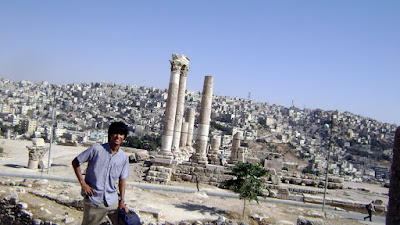 |
| From Jordan |
Roman ruins in Amman
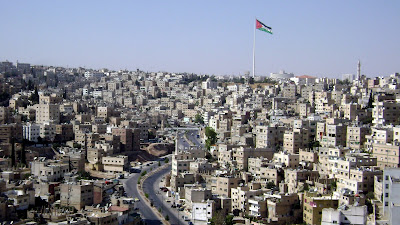 |
| From Jordan |
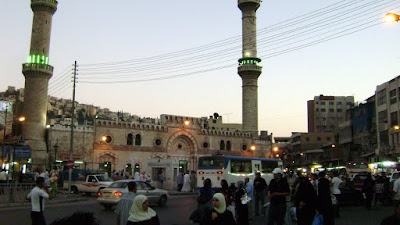 |
| From Jordan |
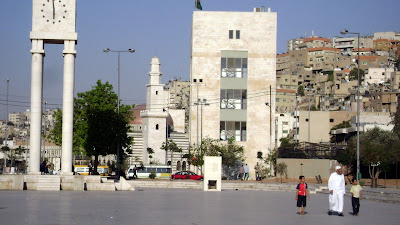 |
| From Jordan |
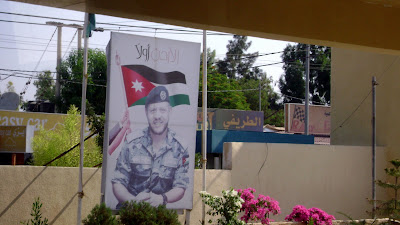 |
| From Jordan |
King Abdullah II, at the border with Palestine (The Occupied West Bank)
